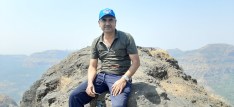
I read about Lonar Lake long ago in 1986, in a leading Science Magazine. I was a college student then studying at Yavatmal and was surprised to know that a unique site on the earth exists in my own state, Maharashtra. Surprisingly it was not very well known like other attractions in the state. My father was posted in Buldhana then and Lonar is a part of the same district. Later I got admission at SGGS College of Engineering and Technology, Nanded for Engineering studies. The route of ST Bus from Buldhana to Nanded passed via Lonar. Every time the bus halted at Lonar, I yearned to see the lake but somehow never had an opportunity. Several years passed but I could not visit the lake although it always remained in my mind.
Finally in February 2020, I had to travel from Pune to Akola and I planned to drive. This was the best opportunity to drop at Lonar but we started late in the morning so again the lake gave me a slip. My wife and daughter accompanied me in the journey.
On the return journey however we started early. I had a good feel of the road by then. There is a town called Sultanpur about 12 kms from the lake. Sultanpur onwards the road to Pune is excellent. Once I reached Sultanpur I was confident of making it to Pune by evening so decided to take a detour.
In view of keeping on to the good road we took a turn at a village called Bibi. After some initial rough patches we reached the Dusarbid – Lonar road which is again excellent. You can easily drive at 80 – 100 kms/hr. About 15 minutes of drive and Google Maps showed that we were reaching the lake. There was a resort and a closed gate at the indicated location so we drove a little further and the wonder was on our right. It showed up suddenly.
A completely different looking green lake, situated in the middle of a crater, protected with a fencing around the area. Entrance to the lake was another kilometer ahead.
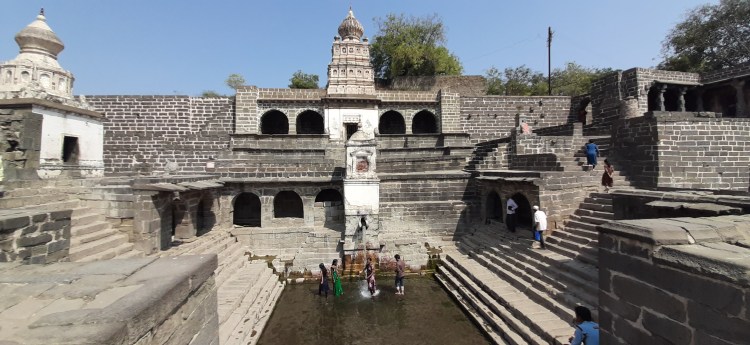
There is a small ground where the vehicles can be parked. It was pleasant to see no one rushing on to you to collect parking fees. A forest guard asked us to make entries in a register at the entrance. There is a small garden developed at the entrance and the path is lined with neat stone steps. After a short walk we reached Gomukh where water flows continuously through a cow’s mouth in a properly constructed ‘kund’ People can be seen standing under the water taking holy bath. The lake was visible at a distance.
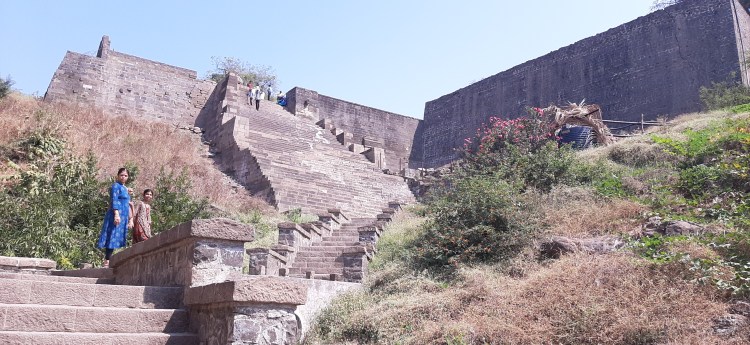
Next to the kund is a series of steep steps. As we continued our climb downwards, some young folks advised us not to go far as they said the return would be difficult. We carried on. Water from the gomukh flows on the left along with the steps and you can see some small waterfalls.
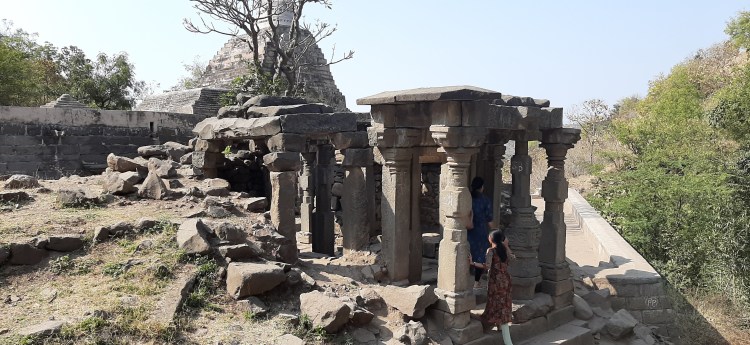
The path entered a dense forest as the steps ended. There was no one around. We came across couple of ancient temples in ruined state. They are being restored. As we progressed the forest started becoming denser and the surrounding silent. A leopard had been spotted a week earlier so my wife started getting nervous. There was no clue of the distance to the lake even after walking for about 15 minutes and my family was getting restless. Finally we saw a patch of dense thicket and decided to return back. I was sad we were going to miss the opportunity to go closer to the lake which had come so close after a long wait of years.
Luckily we met Mr. Gautam Shejule, an employee of the forest department. He was walking to his post. He assured us that the forest was perfectly safe and encouraged us to go to the lake. He gave me his phone number. After his assurance my wife was happy and we started for the lake again. On the way we came across a tamarind tree near a ‘Durgah’ and saw a number of ‘imlis’ lying on the ground. We picked up some and decided to pluck some more on the way back. Another 5 minutes of walk and we reached the lake.
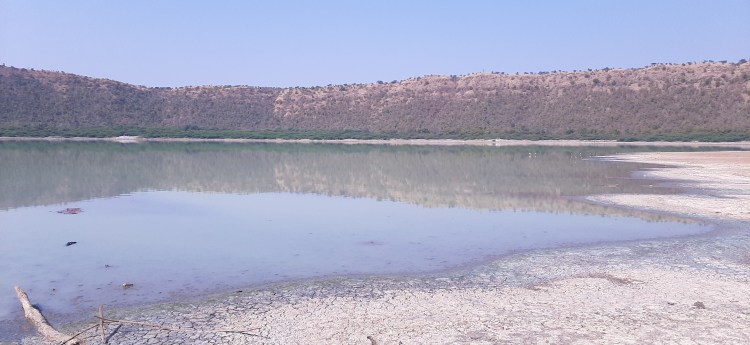
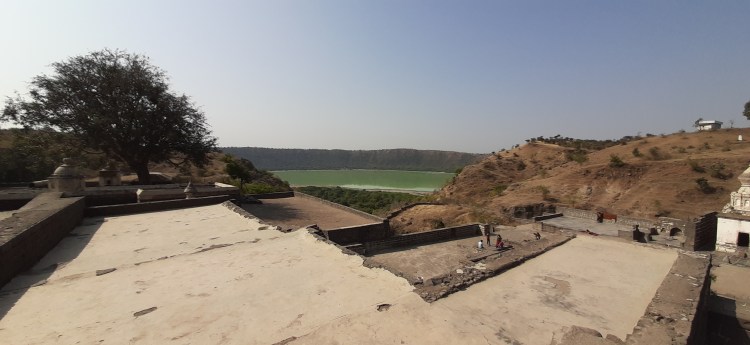
The water had retreated about 200 meters from the starting point where it may be reaching in rainy season. There was yellow soil all over and we could see a number of trees in the path which had been cut down. The lake is almost 500 feet below the ground level. It was created as a meteorite hit the earth about 50000 years ago. Impact of the metorite might have created this deep crater. Water is green and calm. Could not see any waves on the surface. A number of migratory birds could be spotted in the water. The slopes aorund the lake are green with dense forest. At far distance we could spot a group of foreigners walking back. The water is alkaline and I wanted to taste it. It was stinking badly and looked dirty but still I decided to taste a drop. As I was about 6 feet from the lake I realised the swamp. The edge of the lake was surrounded by a very thick, sticky black mud and it was impossible to reach the water so I had to give up.
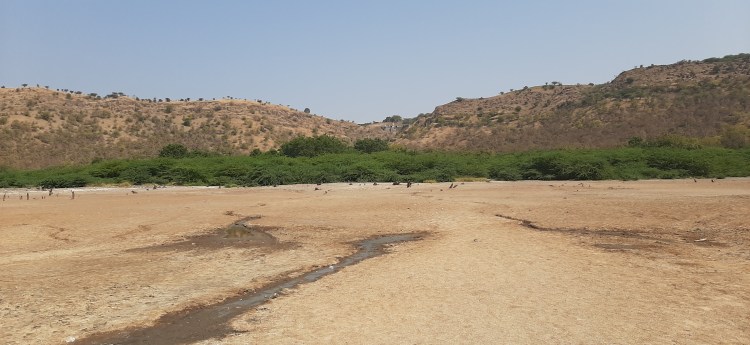
It is impossible these days to find any attraction free of tourists in India and here we were completely alone. The lake was all for us and there was no one to disturb the photographs.

We started our return. A group of monkeys had occupied the ‘Durgah’ now and they looked really wild. There was no question of playing with imli tree now so we quietly continued. The two foreigner girls seen earlier near the lake were accompanied by a guide and they had spotted a king cobra. The return journey was quick and now we could see a number of tourists entering the park. Temperature was already rising and I wondered how they were going to make it.
For me it was a dream coming true after a long wait.

 Curious Explorer
Very well written prasad!
LikeLike
Thank you Santosh
LikeLike
Expressed very well Prasad ! I appreciate your feelings ! Keep it up..!
LikeLike
Thanks Gajanan
LikeLike
Nicely written Prasad. Keep traveling and keep writing.
LikeLike
Very nice Prasad!! Very tempted to visit the place which hopefully will be sooner than later.
And of course very well written 🤗
LikeLike
Excellent narration, Prasad! Your penchant for travel and visiting places is evident from the way you have written. Keep going and keep writing…
LikeLike